

How Do I Write Off Roof Repairs From Huricane Harvey
How Do Hurricanes Form?
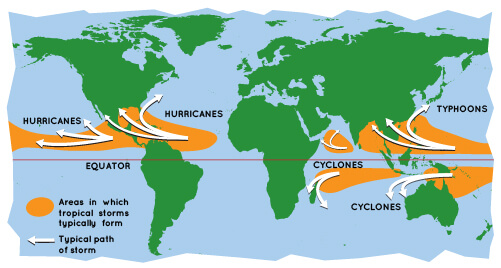
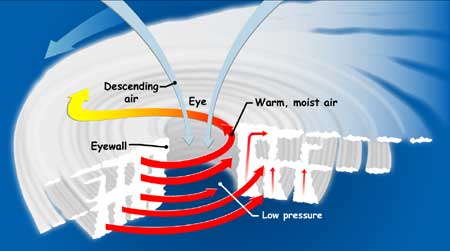
Hurricane Fran. Prototype fabricated from GOES satellite data. Hurricanes are the near violent storms on Earth. People phone call these storms past other names, such every bit typhoons or cyclones, depending on where they occur. The scientific term for all these storms is tropical cyclone. Only tropical cyclones that grade over the Atlantic Ocean or eastern Pacific Bounding main are called "hurricanes." Whatever they are called, tropical cyclones all form the same way. Tropical cyclones are like giant engines that utilize warm, moist air as fuel. That is why they form only over warm ocean waters near the equator. The warm, moist air over the ocean rises upward from near the surface. Considering this air moves up and away from the surface, in that location is less air left near the surface. Another way to say the same thing is that the warm air rises, causing an surface area of lower air pressure beneath. A cumulonimbus deject. A tropical cyclone has so many of these, they form huge, round bands. Air from surrounding areas with college air pressure pushes in to the low force per unit area expanse. Then that "new" air becomes warm and moist and rises, besides. Equally the warm air continues to rise, the surrounding air swirls in to take its identify. Every bit the warmed, moist air rises and cools off, the water in the air forms clouds. The whole arrangement of clouds and current of air spins and grows, fed by the ocean'due south rut and h2o evaporating from the surface. Storms that form north of the equator spin counterclockwise. Storms south of the equator spin clockwise. This difference is because of Earth's rotation on its axis. As the storm system rotates faster and faster, an middle forms in the center. It is very calm and clear in the center, with very low air force per unit area. Higher pressure air from above flows down into the eye. If yous could piece into a tropical cyclone, it would await something like this. The minor ruby-red arrows prove warm, moist air rising from the body of water's surface, and forming clouds in bands around the eye. The blue arrows show how absurd, dry air sinks in the eye and between the bands of clouds. The large red arrows bear witness the rotation of the ascension bands of clouds. When the winds in the rotating storm reach 39 mph, the storm is chosen a "tropical storm." And when the wind speeds reach 74 mph, the tempest is officially a "tropical cyclone," or hurricane. Tropical cyclones usually weaken when they hit land, because they are no longer being "fed" by the energy from the warm ocean waters. However, they ofttimes move far inland, dumping many inches of pelting and causing lots of wind harm earlier they dice out completely. Tropical cyclone categories: The two GOES satellites keep their optics on hurricanes from far in a higher place Earth'south surface—22,300 miles above, to be exact! (Learn more about this kind of orbit.) These satellites, built by NASA and operated by the National Oceanic and Atmospheric Administration (NOAA), salvage lives by helping weather forecasters predict and warn people where and when these severe storms volition hit land. Our Earth: What is a Hurricane?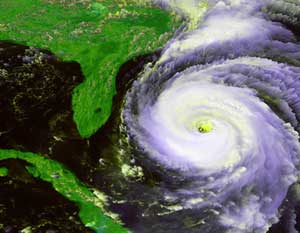
Category Wind Speed (mph) Damage at Landfall Storm Surge (anxiety) 1 74-95 Minimal 4-5 2 96-110 Moderate half-dozen-8 3 111-129 Extensive 9-12 4 130-156 Extreme xiii-eighteen 5 157 or college Catastrophic 19+
Related Resources for Educators
Real World: Hurricane Hunters
NASA's Optics on Farthermost Weather condition
If you liked this, y'all may like:

Source: https://spaceplace.nasa.gov/hurricanes/en/
Posted by: priceforomed.blogspot.com
0 Response to "How Do I Write Off Roof Repairs From Huricane Harvey"
Post a Comment